
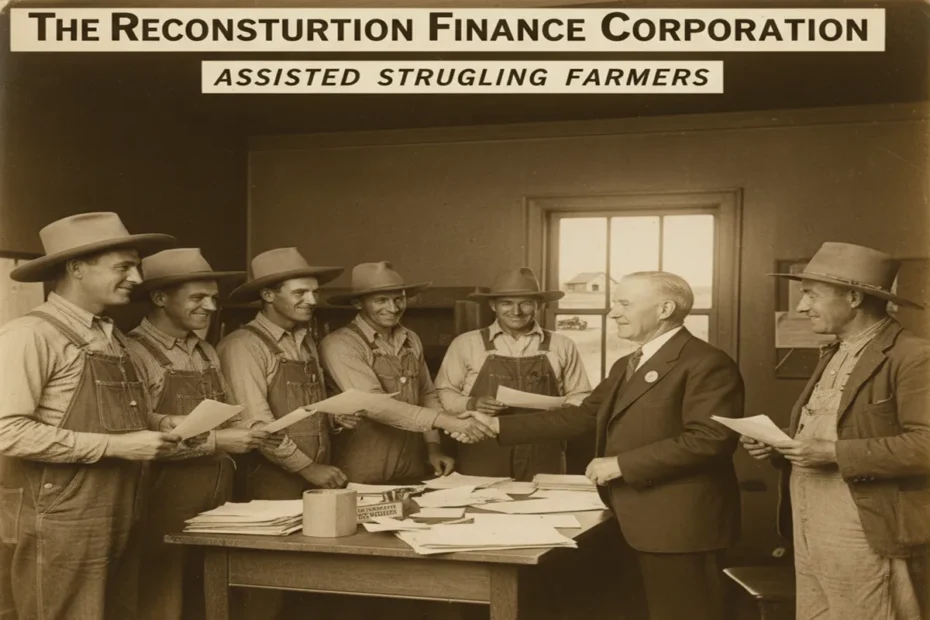
During the darkest days of the American Great Depression, one significant government agency stood between disaster and recovery for many agricultural families: the Reconstruction Finance Corporation. Specifically, the Reconstruction Finance Corporation assisted struggling farmers by channeling emergency financing and restructuring support that provided a lifeline when crop prices collapsed and foreclosures loomed. In this article, we will explore how the Reconstruction Finance Corporation assisted struggling farmers, why its role was vital, what mechanisms it employed, and what legacy it left in American agricultural policy.
The origins of the effort
The Reconstruction Finance Corporation (RFC) was established on January 22, 1932, under the Hoover administration, with a primary mission “to provide emergency financing facilities for financial institutions, to aid in financing agriculture, commerce, and industry.” From its very inception, one of the RFC’s mandates was agriculture: to assist those sectors most severely impacted by the economic collapse. Thus, the Reconstruction Finance Corporation assisted struggling farmers as part of its broader mandate to stabilise finance, commerce, and industry across the United States.
Why farmers were in crisis
By the early 1930s, American farmers faced a triple blow: plunging crop prices, drought in many regions, and high debt loads pinned to equipment, land, and mortgages. Many small and tenant farmers, especially in the South and Midwest, found themselves unable to cover the costs of seed, fertilizer, feed, and debt service. Recognising the urgency of the crisis, Congress authorised the RFC to extend its lending powers further, including to finance rural credit institutions and farms themselves. In other words, the Reconstruction Finance Corporation assisted struggling farmers not just passively but through dedicated funds targeted at their production costs and indebtedness.
How the RFC intervened for agriculture
The way the Reconstruction Finance Corporation assisted struggling farmers was multi-faceted. First, the RFC made loans or advances to agricultural credit corporations, livestock and farm mortgage associations, which in turn extended credit to farmers. For example, by 1939, agriculture had been accorded some $3.1 billion in RFC loans through such channels. Second, the RFC directly enabled seed-purchase loans: in one statement, the White House cited that the RFC made “loans to the extent of $75 million … for seed purposes through the Department of Agriculture,” helping hundreds of thousands of farmers. Third, the RFC used its subsidiary, the Commodity Credit Corporation (CCC), to purchase crops and establish price supports, thereby raising farm incomes and reducing the pressure of the debtors on farmers. In each of these ways, the Reconstruction Finance Corporation assisted struggling farmers with both credit relief and market-support mechanisms.
Key highlights of agricultural assistance
To illustrate the scale: during the New Deal years, the RFC’s assistance to agriculture ranked second only to its help to the banking sector in magnitude. The RFC provided over $2.5 billion to agricultural financing institutions; more than $1.6 billion of that went to the CCC. And the agency’s efforts included postponement of farm mortgage foreclosures and interest-rate relief as authorized by legislation allowing the RFC to make loans “to farm mortgagors… to secure the postponement of foreclosures… and to make payment of interest” for two years. This means that the Reconstruction Finance Corporation assisted struggling farmers by directly intervening to stabilise their debt service and prevent widespread land loss.
Why this assistance mattered
The impact of these interventions cannot be overstated. Farmers were a key pillar of rural America, both economically and socially. When the Reconstruction Finance Corporation assisted struggling farmers, it helped preserve rural communities, maintained agricultural output, and kept the credit system from imploding in the countryside. The RFC’s work helped shore up rural credit markets, which in turn prevented more aggressive bank failures and land-foreclosure waves. Moreover, by enabling the extension of electricity and rural appliances via programmes like the Electric Home and Farm Authority itself, funded in part by RFC operations, the Reconstruction Finance Corporation assisted struggling farmers not only in crisis moments but also in modernising their infrastructure.
Challenges and limitations
However, the story of how the Reconstruction Finance Corporation assisted struggling farmers is not entirely one of triumph. Much of the relief still required robust oversight, and some critics argue that the RFC’s lending preferences sometimes favoured larger institutions over the smallest farmers. Moreover, while the RFC did provide substantial aid, it was part of a broader set of New Deal interventions so the RFC alone did not solve the farm crisis. Yet, within its mandate, the Reconstruction Finance Corporation assisted struggling farmers more directly than many people realise.
Legacy and closing
By the time the RFC was dissolved in 1957, it had played a pivotal role in American economic recovery and agricultural stabilisation. The fact remains that the Reconstruction Finance Corporation assisted struggling farmers during a period when the alternative may have been mass foreclosures, farm abandonment, and widespread rural collapse. The agency’s model, using credit relief, market support, and partnership with agriculture-specific institutions, offers lessons for modern policy makers facing agricultural distress. Today, when we reflect on how the Reconstruction Finance Corporation assisted struggling farmers, we see that strategic federal intervention in times of crisis can preserve not just individual livelihoods but the broader economic infrastructure of rural America.
In conclusion, the Reconstruction Finance Corporation assisted struggling farmers through direct loans, support for agricultural credit institutions, foreclosure relief, and market-stabilisation mechanisms. That support, though not perfect, played a significant and often under-appreciated role in the recovery of U.S. agriculture during the Depression era.
FAQs:
1. What was the Reconstruction Finance Corporation (RFC)?
The Reconstruction Finance Corporation was a U.S. government agency created in 1932 to provide emergency loans to banks, industries, and agriculture during the Great Depression.
2. How did the Reconstruction Finance Corporation assist struggling farmers?
The RFC provided loans to agricultural credit institutions, financed farm mortgage relief, and supported crop price stabilization through the Commodity Credit Corporation.
3. Why were farmers struggling during the Great Depression?
Farmers faced collapsing crop prices, heavy debt, and drought conditions, which made it difficult to maintain their livelihoods and repay loans.
4. What was the impact of RFC assistance on farmers?
The RFC’s financial aid helped prevent widespread farm foreclosures, stabilized rural economies, and improved credit access for farmers across the country.
5. What is the legacy of the Reconstruction Finance Corporation’s work with farmers?
Its success in stabilizing agriculture influenced future government programs for farm aid and demonstrated the importance of federal intervention during economic crises.