
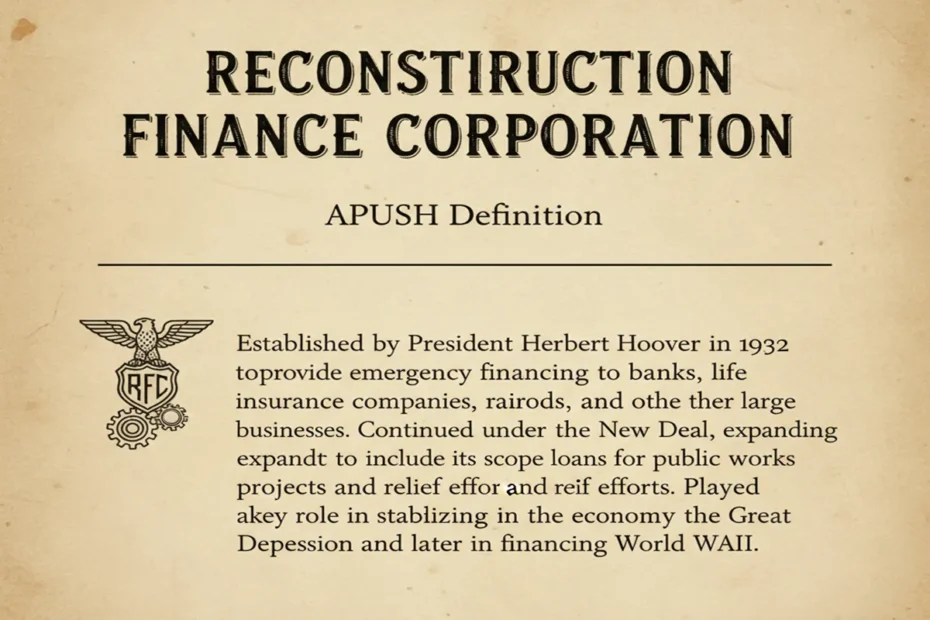
When studying the Great Depression era in U.S. history, one of the pivotal institutions students of AP U.S. History must understand is the Reconstruction Finance Corporation. In this article, we’ll explore the Reconstruction Finance Corporation APUSH definition, outline its origins, functions, expansion, legacy, and why it matters in the AP US History context.
Definition and Origins
A clear Reconstruction Finance Corporation APUSH definition is: a federal agency created on January 22, 1932, for the purpose of providing emergency financing to banks, railroads, agricultural institutions, and ultimately state and local public works during the worst years of the Great Depression. Under the administration of Herbert Hoover, and at the recommendation of Eugene Meyer of the Federal Reserve, the agency modeled after the earlier World War I-era War Finance Corporation was born in a time of banking collapse and economic panic. In AP US History terms, this agency marks a significant turn toward greater federal intervention in the economy, making it a key term for the “Hoover and the Great Depression” era.
Initial Purpose and Early Activities
Originally, the Reconstruction Finance Corporation apush definition emphasizes its role as a “lender of last resort” to financial institutions that could not access normal credit channels: banks, mortgage associations, and railroads. In practice, the agency received an initial $500 million in capital from the U.S. Treasury and was authorized to borrow billions more for its work. During the early months of 1932, RFC loans helped reduce bank suspensions and the hoarding of currency. Although its impact was limited by factors like public disclosure of recipients (which discouraged borrowing) and the deep structural problems of the banking system.
Expansion under the New Deal
While the Reconstruction Finance Corporation APUSH definition originally focused on banks and railroads, its scope quickly broadened under Franklin D. Roosevelt and the New Deal. Amendments in July 1932, via the Emergency Relief and Construction Act, authorized RFC to make loans for public‐works projects, state and municipal relief, and agriculture. The RFC also began purchasing preferred stock of banks, making capital available to ensure stability, and later financing wartime industry during World War II. For AP students, this evolution of the RFC illustrates how federal policy shifted from hands-off to more active intervention.
Significance in the AP US History Context
Why does “Reconstruction Finance Corporation apush definition” matter for the AP US History exam?
-
It serves as a concrete example of Hoover’s response to the Depression: while Hoover initially believed in voluntary business cooperation, the RFC represented one of the most significant federal actions of his presidency.
-
It marks the transition to the New Deal era: the agency’s expansion shows how FDR’s administration inherited and magnified the tool, turning it into an engine for relief, recovery, and war mobilization.
-
It highlights debates about government and the economy: critics argue the RFC favored large banks and industries rather than ordinary Americans, which raises questions about equity and federal power.
-
It links to broader themes: banking crises, unemployment, public works, wartime production, and the changing role of the federal government.
Legacy and Criticisms
The Reconstruction Finance Corporation APUSH definition also involves its legacy and the mixed assessment of its success. From one vantage point, the RFC’s lending prevented some bank failures and provided vital capital in a collapsed economy. On the other hand, it was criticized for being too conservative early on (preferring solvent institutions) and for the requirement to publish borrowers’ names, which discouraged distressed banks from seeking help. Moreover, questions remain about how much the RFC actually stimulated employment or recovery—its focus on large institutions meant aid did not always “trickle down” rapidly. The corporation was gradually wound down after the war, with lending powers ending in 1953 and full liquidation by 1957. Its functions helped spawn later institutions like the Small Business Administration and Federal National Mortgage Association (“Fannie Mae”).
Tips for AP US History Students
When you encounter Reconstruction Finance Corporation APUSH definition in your study set or exam:
-
Memorize the core definition: created in 1932, the emergency financing of banks/railroads, expanded under the New Deal.
-
Place it in context: late Hoover years, early New Deal; part of shifting federal policy.
-
Note its functions: lending to banks, railroads, local governments; public works, war production.
-
Observe the significance: example of federal intervention, shifts in governmental role, foundation for later agencies.
-
Remember criticisms: limited scope initially, perception of elitism, and transparency issues.
-
Connect to themes: Great Depression, banking crisis, economic regulation, wartime mobilization.
Conclusion
In sum, the Reconstruction Finance Corporation APUSH definition encapsulates both a specific institution and a broader shift in how the federal government responded to economic crisis in the United States. By understanding its origins, evolution, significance, and legacy, AP US History students gain a clearer view of the complexities of the Great Depression and New Deal era. Whenever you see the term on a review sheet or exam prompt, you’ll be ready: it stands for federal emergency finance, shifting policy, and the changing role of government in American economic life.
FAQs:
1. What is the Reconstruction Finance Corporation (RFC) in APUSH?
The RFC was a federal agency created in 1932 to provide emergency financing to banks, railroads, and other institutions during the Great Depression.
2. Why was the RFC created?
It was established to stabilize the banking system, prevent further economic collapse, and support public works and relief programs.
3. How did the RFC expand under the New Deal?
Under FDR, the RFC’s role expanded to include loans for state and local projects, agriculture, and wartime industry, making it a key tool for economic recovery.
4. What is the Reconstruction Finance Corporation APUSH definition?
It refers to a government agency that lent emergency funds to banks and businesses during the Great Depression, illustrating early federal intervention in the economy.
5. What is the legacy of the RFC?
The RFC helped prevent some bank failures, supported economic recovery, and influenced future federal agencies like the Small Business Administration and Fannie Mae.